
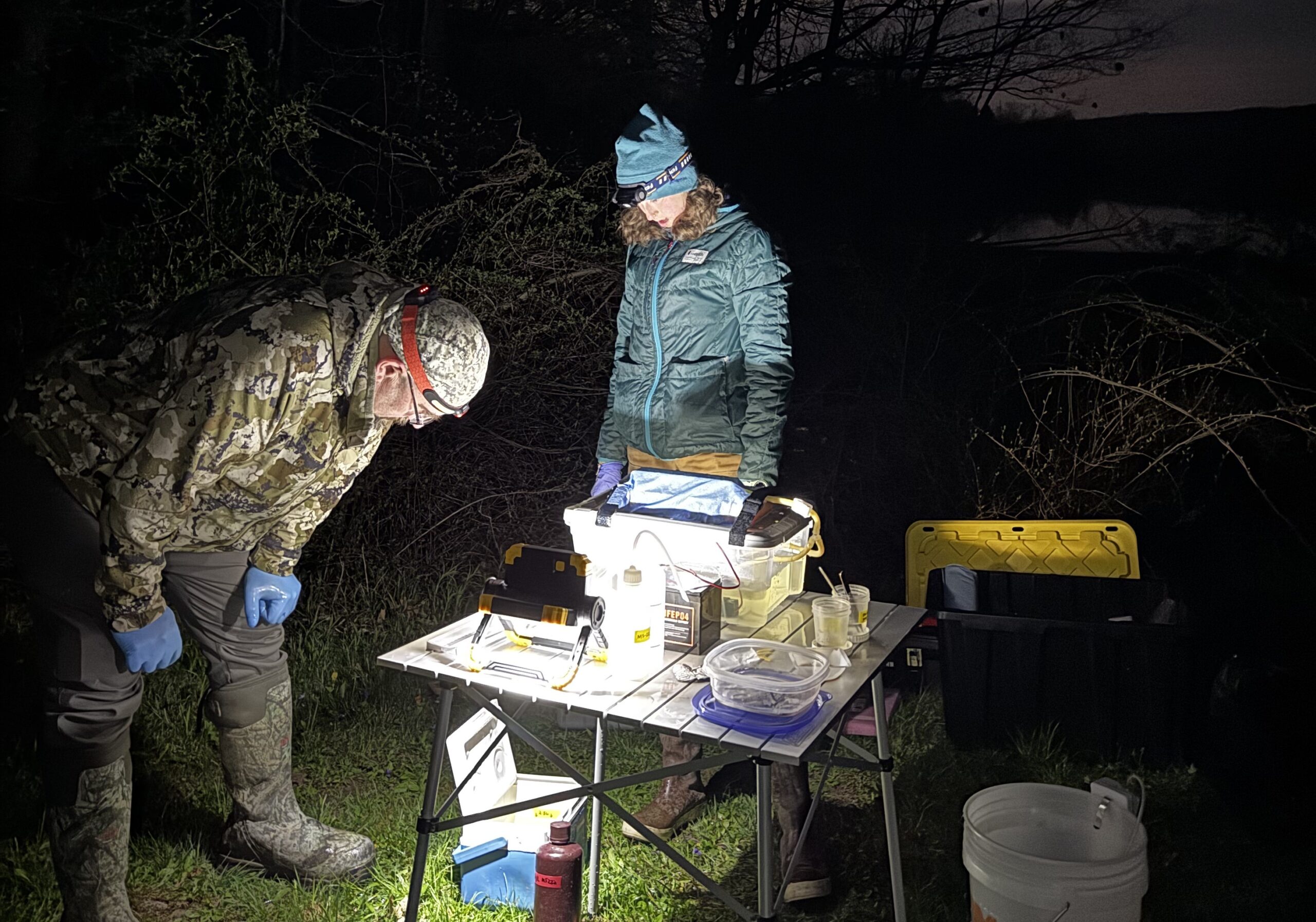
Dan Kusnierz (left) and Sasha Milsky (right) implant an acoustic tag in a rainbow smelt by moonlight. Photo by Shantel Neptune
In May 2025, Sasha Milsky found herself on the banks of the Penobscot River, watching thousands of rainbow smelt swim up inch-deep tributaries on their way to spawning grounds. With flashlights and headlamps, she and a team from the Penobscot Nation, University of New Hampshire (UNH) and University of Maine (UMaine) scooped fish after fish from the water, implanting each with an acoustic tag.
Milsky had expected to see a later spawning run in the Penobscot when compared to New Hampshire’s Great Bay to the South, where her lab has conducted studies in the past. But Penobscot smelt were exhibiting surprising behavior. A late March run had already brought Milsky up from UNH, where she is a master’s student in the Fish and Movement Ecology Lab. The team worried that they had missed the major smelt run, making it difficult to tag the fish needed for the study.
Locals assured the researchers that there would be a second run in May. They were right.
“When we went up there in May, we weren’t even dip netting. We were grabbing fish out of the water with our bare hands,” says Milsky.
“Some of these streams that they swim into are very small. So I could see why people could kind of write those little places off … but when you go there and see thousands of rainbow smelts coming up into there, just climbing over one another, it’s pretty spectacular,” says Kusnierz, Manager of the Penobscot Nation Water Resources Program.
This tagging effort was part of a larger project using acoustic telemetry and chemical analysis to study sources of contamination in anadromous fish. It comes out of a collaboration between the Penobscot Nation and researchers at UNH and UMaine who lead sister studies on rainbow smelt and striped bass.

With a watershed that blankets 8,570 square miles of the Maine highlands, the Penobscot is the second largest river in New England. It is home to several species of anadromous fish that migrate from the sea to fresh inland waters to spawn. In recent years, the river has been the focus of efforts to remediate high levels of mercury and other contaminants.
Following a settlement with Holtrachem, the company responsible for much of the mercury pollution in the lower Penobscot, the Greenfield Penobscot Estuary Projects Trust was established to distribute funds for restoration projects. While not a party to the suit, the Penobscot Nation received settlement funds through several restoration grants.
In 2017 and 2018, Kusnierz led a study in collaboration with the Environmental Protection Agency to assess contaminant levels in anadromous fish. They knew that resident fish, which stay in the Penobscot year-round, were contaminated. However, they expected to find lower levels of contaminants in anadromous fish because they spend less time, and crucially less feeding time, in contaminated waterways.
“Lo and behold, we found out that most of the species that we tested had a lot of contamination,” says Kusnierz, “Dioxin and PCBs were the were the big ones that were of most concern, but we also found some pretty high levels of mercury in some of those species.”
The fish also contained PFAS, a group of chemicals known for negative health outcomes in humans and wildlife and slow degradation times. As a result, the Agency for Toxic Substances and Disease Registry (ATSDR) recommended that humans avoid consuming fish caught in the Penobscot.

This was concerning for the Penobscot Nation, because species that represent culturally and nutritionally important food sources for tribal citizens were contaminated. “There’s a relationship there where these fish not only provide subsistence for folks… there’s also a kinship relationship as well,” Charles Loring Jr., Director of the Penobscot Nation Department of Natural Resources, explains.
From an ecological perspective, rainbow smelt form an important link in the local food web. “Things like striped bass, Atlantic salmon, Atlantic cod, all eat rainbow smelt,” Milsky explains, “They’re the first anadromous fish to swim upstream when the temperatures start to warm up in early spring. They’re spawning and laying their eggs early, and those juveniles are coming into the estuary right at a time when those larger fish are coming in to utilize this system.”
With her advisor, Dr. Nathan Furey, Milsky uses acoustic telemetry to understand how smelt use different parts of their habitat and time migrations to spawning areas. In the first year of their study, the UNH team tagged 50 smelt, which they tracked through a receiver array maintained by UMaine, NOAA, and the Maine Department of Marine Resources. They hope to develop a detailed, system-specific life history for Penobscot rainbow smelt.
Furey says that the multi-part spawning behavior they observed raises new questions, such as, “Are there truly fish that come in later than others? And are their habitats different than the others? Is it one long window, or are there distinct pulses?”
As benthic feeders, rainbow smelt can transfer mercury in sediments to predators and the humans that consume them. However, the research team is careful to emphasize that their study considers only a small segment of the smelt’s life that doesn’t necessarily overlap with when they may be exposed to the highest mercury levels through feeding.

Moving up the food web, Andrea Casey, a master’s student at UMaine, is leading a project focused on striped bass in collaboration with staff at the Penobscot Nation Department of Natural Resources. Casey has been working on striped bass with her advisor, Joseph Zydlewski, since she was an undergraduate. Striped bass is major sport fishery across the East Coast and a favorite target species for many tribal citizens.
Casey will use acoustic detections to compute a weighted residency index for striped bass. Combining information about contamination levels in the river with a weighted residency index will help her determine what proportion of the time a fish is recorded in the Penobscot is within highly contaminated sections of the river. This year, Casey plans to tag 50 striped bass.
Casey will evaluate mercury contamination in striped bass cold vapor atomic absorption spectroscopy, a technique which allows her to measure the mercury concentrations in tissue samples, many of which were donated by tribal citizens. She will compare analyses of otoliths, ear stones that accumulate calcium carbonate from the food they consumer and water they swim in. Chemical analyses of these otoliths can be used to develop inferences about a fish’s location throughout its life. Casey will pair this information with analyses of the striped bass’ optical lenses, which can be used to describe contamination exposure, allowing her to understand when and where a fish had the highest exposure to mercury.
“Hopefully, in the end we’ll be able to say that a certain length fish, or a certain age fish, or a fish caught at a certain time of year is the most likely to be contaminated,” says Casey.
Working in tandem with UNH researchers, staff at the Penobscot Nation DNR will collect rainbow smelt and follow similar methods to analyze mercury contamination and otoliths. Ultimately, the Penobscot Nation will use the information from these two studies, as well as their own analyses, to inform restoration efforts and consumption guidelines for striped bass and rainbow smelt.
“I don’t know if we’ll ever see populations where we could net them as a community again,” says Loring, “It’s a different world than it was thousands of years ago, or even a couple hundred years ago, but it would be really neat to be able to see that type of harvest so everybody in the community could capitalize on what’s out there.”
For more information, visit ACT Network Project PRSMELT.

Follow the ACT Network on LinkedIn to learn more.