

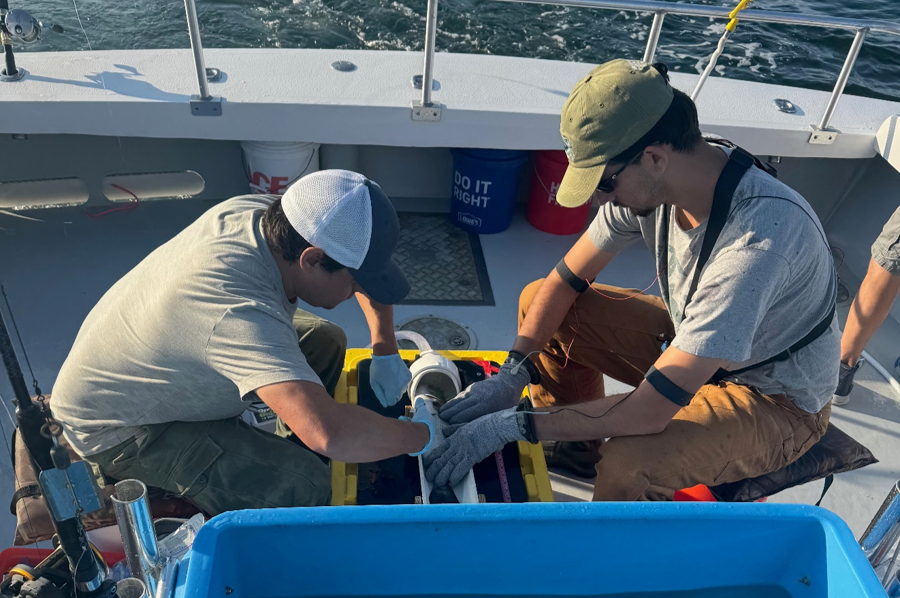
Fisheries Conservation Lab members Allie Blanchette (left) and Rob Aguilar (right) implant a blue catfish with an acoustic tag. Photo credit: Henry Legett / SERC.
At the Smithsonian Environmental Research Center (SERC), Dr. Allie Blanchette, postdoctoral researcher in the Fisheries Conservation Lab, is using acoustic telemetry to study three target species in the Chesapeake recreational fishing sector: bluefish, Spanish mackerel, and blue catfish. Her research is driven by two aims: develop more detailed information about these species’ migration and habitat use in the region and contribute data that can inform management.
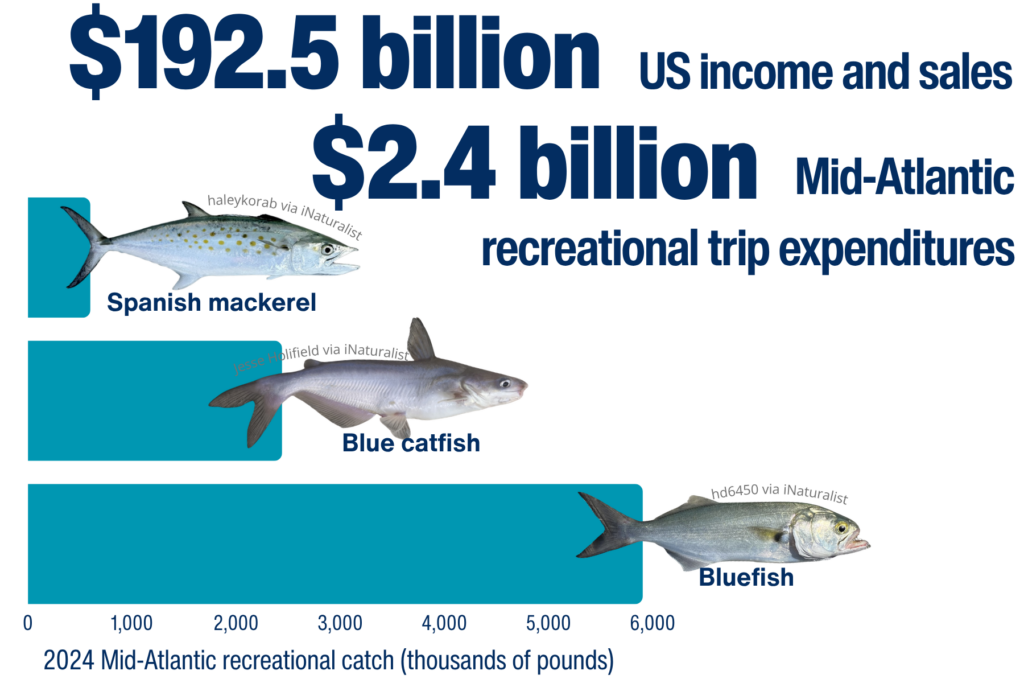
In 2023, the recreational fishing industry contributed an estimated $192.5 billion in sales and income and 700,000 jobs to the US economy, according to a report by the National Oceanic and Atmospheric Administration (NOAA). The Mid-Atlantic region alone accounted for $2.4 billion in recreational trip expenditures in 2023. Despite its substantial economic and ecological impacts, the US recreational fishing industry is typically subject to less strict monitoring and reporting rules compared to commercial vessels. Growing recognition of the pressure that recreational fishing can place on fish stocks has motivated research on species frequently targeted by anglers.
Spanish mackerel and bluefish: summer visitors to the Chesapeake
In the Chesapeake, bluefish and Spanish mackerel are two popular summer catches, prized for their aggressive fighting and tasty meat. In 2024, Mid-Atlantic recreational anglers landed nearly six million pounds of bluefish and over half a million pounds of Spanish mackerel, according to NOAA’s Marine Recreational Information Program. Bluefish is Maryland’s most popular summer recreational fishery and 90% of bluefish harvested in the state are caught by sport fisherman, according to the Maryland Department of National Resources.
Bluefish and Spanish mackerel are interesting from a movement ecology perspective because their migrations bring them into the Chesapeake Bay in summer and out to open waters in winter. However, there is much we don’t know about how they are using these different habitats.
What we’re trying to figure out is, once they’re in the bay, where they go and what habitats they are using. What water bodies are they going to? And likewise, when they leave, where are the individuals that inhabit the Chesapeake Bay going?” says Blanchette.
Tracking bluefish and Spanish mackerel through acoustic telemetry will help Blanchette answer these questions. She and her team have tagged 49 bluefish, 21 of which have been detected. In summer 2026, they will focus their tagging efforts on Spanish mackerel.
The case of the blue catfish
The Virginia Department of Wildlife Resources introduced blue catfish to the Rappahannock and James Rivers in 1974 to stock a new recreational fishery. The Department intended to give recreational fishers an alternative to declining striped bass populations. The introduction succeeded in developing a popular fishery – recreational fishers landed nearly 2.5 million pounds of the species in 2024. However, the blue catfish also sparked concern as the species threatens to overpower local food webs.
One of the ways scientists hypothesize that blue catfish are altering the Chesapeake Bay aquatic community is by increasing predation pressure on blue crabs and smaller forage fish. Blanchette and her team are investigating this interaction, building on previous research in the Lab on one forage fish of concern, the alewife.
Research scientist Dr. Henry Legett studies alewife in the Rappahannock River. When he tracked alewife using acoustic telemetry in the past, Legett occasionally observed unexpected behaviors from some of the tags. These rogue tags were detected in areas not known to host river herring. Further, only 10-15% of tags return to the rivers where they were tagged the following year.
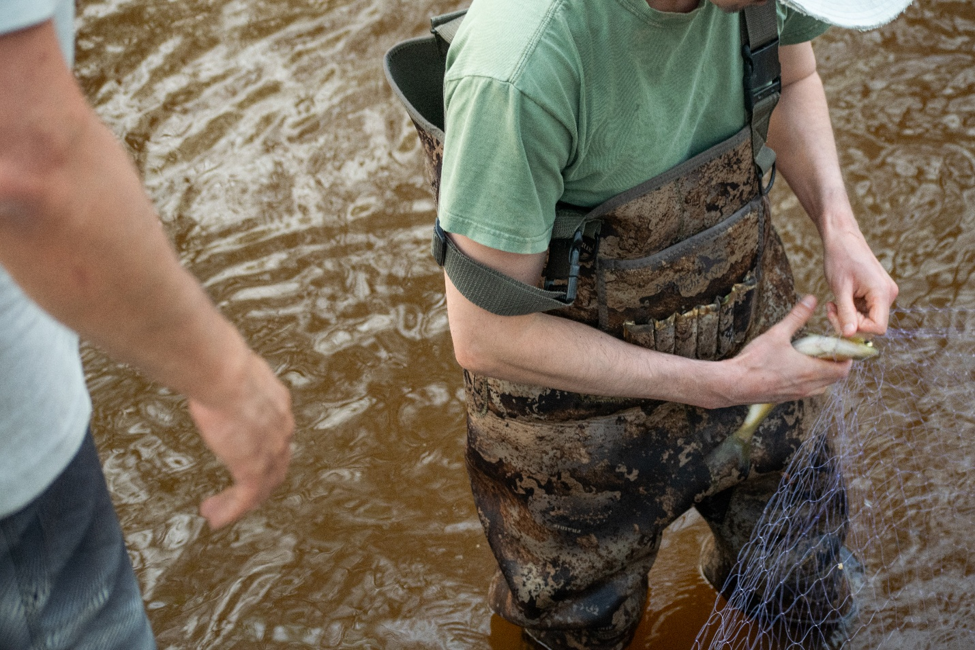
This left him wondering: What happens to the tags that exhibit strange movements or disappear completely? The new predation tags that Blanchette and her team deployed in this study can offer more insights into the fate of these mystery alewife.
V3D predation tags from Innovasea are coated with a polymer designed to dissolve in a predator’s stomach. When a tagged fish is eaten, the polymer dissolves and the tag begins transmitting a second acoustic code, alerting researchers to the prey’s fate. Legett compares it to a pill with a coating that slowly dissolves in the stomach, releasing medicine contained inside.
The Fisheries Conservation team tagged 30 alewife with predation tags and 25 blue catfish with standard acoustic tags in Spring 2026. They sampled predator and prey from the same parts of the Rappahannock. The most recent data shows that predators have consumed two of the tagged alewife, and the team is continuing to collect additional data.
Telemetry studies introduce some uncertainty about the fate of tagged individuals, Legett explains. Using these predator tags, researchers can get rid of one source of uncertainty by separating predation from other sources of mortality. Comparing movements of tagged blue catfish with movements of triggered predation tags and previously tagged alewife that exhibited unexpected behaviors, Blanchette hopes to learn more about how blue catfish use habitats in the Rappahannock River and determine whether they are responsible for the alewife predation events she records.
Acoustic telemetry brings it together
While the sportfish species in this study have long been popular among recreational fishers, they are now also the focus of the researchers at SERC, a reflection of their ecological, as well as cultural and economic importance.
“Focusing on sportfish gives us the opportunity to make new discoveries about popular Chesapeake species that don’t get as much attention as blue crabs and striped bass,” says Dr. Matt Ogburn, principal investigator of the Lab. “It also adds new data to our efforts to understand the many different ways that animals use Chesapeake Bay.”
Tags used in this study were funded by the Merrill Family Foundation, Operational BioTrack, and NOAA. Past alewife tagging mentioned in this story was funded by NOAA and NFWF.

Follow the ACT Network on LinkedIn to learn more.