
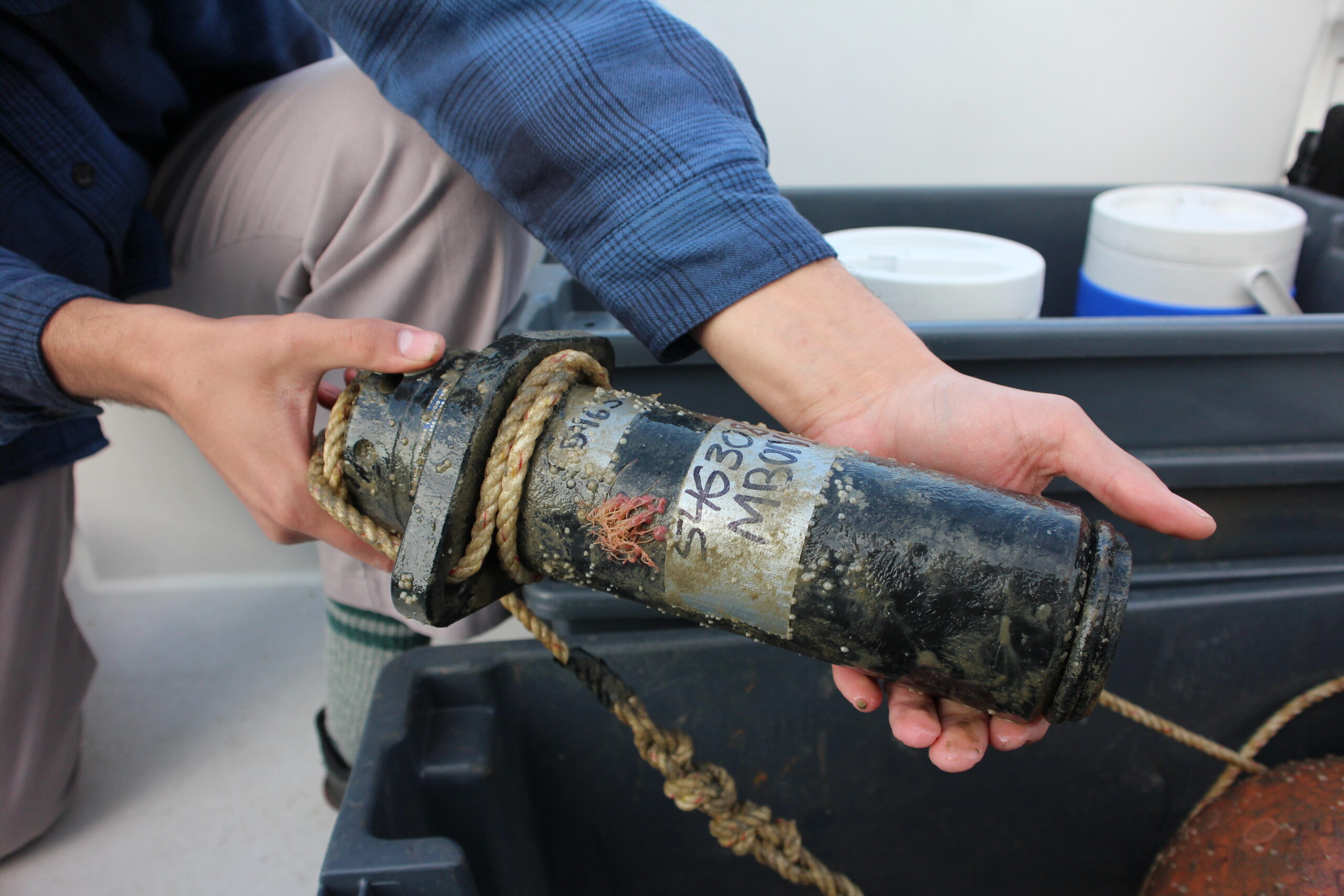
SERC Fisheries Conservation technician, Gabriel Stevenson, holds a recovered acoustic receiver used in the Mid-Atlantic MBON project. Photo by Molly Murphey.
Animals around the world migrate to find favorable conditions to feed, rest, and breed. But they don’t rely on calendars to tell them when to move from one part of their habitat to another, nor do they relocate at random. Research has shown that these animals respond to dynamic changes in temperature and light, wind and ocean currents, and other cues to time their movements. However, further analysis is needed to understand how rapidly changing oceans affect migration, particularly for large marine animals, which have been relatively understudied.
Researchers with the Mid-Atlantic MBON project are developing and testing hybrid biological approaches to marine animal movement research in the area off Ocean City, Maryland. They use a combination of environmental DNA (eDNA), acoustic telemetry, and passive acoustic monitoring (PAM). These approaches complement MARACOOS’ strengths in oceanography with information about where species are distributed, how they use different habitats, when and where they migrate, and how these migrations relate to seasonal and environmental variation.
The Mid-Atlantic Bight, the area between Cape Hatteras, North Carolina, and Martha’s Vineyard, Massachusetts, is characterized by dynamic change. Temperature, oceanographic processes, and powerful storms drive seasonal variation in biodiversity. The region serves as a central part of a long-distance migration corridor for iconic endangered species such as North Atlantic right whales and Atlantic sturgeon, as well as important fishery species such as striped bass and coastal sharks. Commercially important species such as Atlantic sea scallops and black sea bass are year-round residents.
A recent paper by MBON researchers Dr. Dave Secor, Mike O’Brien, and Dr. Helen Bailey proposes that marine animals in Mid-Atlantic Bight exhibit migrations along networked habitat stopovers. These movements are similar to flyways first proposed for birds in the 1930s. Long-term monitoring studies along the transect that now hosts the Mid-Atlantic MBON project provided the impetus for the flyway concept, according to Secor, professor at the University of Maryland Center for Environmental Science (UMCES) and co-lead scientist on the project. He says that an expansion of observing networks in the Atlantic could allow researchers to capture not only snapshots of passing animals in specific locations, but a picture of animal movement throughout the region.
“We are at the nexus of biogeographical realms between the South and Mid-Atlantic Bight. We see a lot of southern migrants coming up, fishes, whales, turtles, and we see northern fish. We even see some transatlantic migrants,” says Secor. “We know that the areas off Ocean City are used by a diversity of migratory animals, and we often explore them one at a time. Now, we have an opportunity to look at them jointly as a community of animals migrating through our area.”
With such a diversity of ocean life, multiple monitoring approaches are needed. One of these approaches – PAM – involves deploying either acoustic recorders that record audio files of the full soundscape, including baleen whales, or echolocation click detectors that recognize and log sounds produced by odontocetes (an order of cetaceans with teeth that includes dolphins and porpoises).
“This is really useful for species that are endangered, such as the critically endangered North Atlantic Right Whale, where doing more hands on and invasive work, such as tagging animals, could be detrimental to the long-term health and survival of that population,” explains Caroline Tribble, faculty research assistant at UMCES.
Recorded soundscapes also provide information about human activities on the water, which can inform conservation efforts for marine animals that use and are sensitive to noise.
“Lots of people think that the ocean is a very quiet place. They think of it as very peaceful. Actually, it’s incredibly noisy, particularly in these coastal areas,” says Bailey, director of Blue Wave consulting and a co-lead scientist on the project, “The more we learn, we realize that, actually, there’s more and more species that depend on sound to communicate and find mates, and all of this is really crucial to them. And yet, we’re really not paying attention to it.”
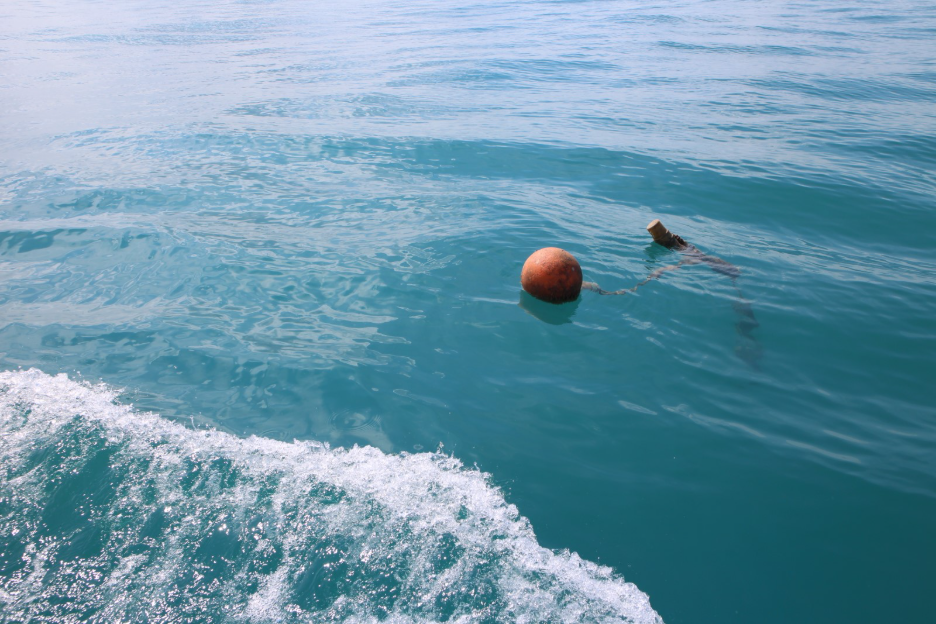
Researchers can monitor other marine species using acoustic telemetry, a method that involves tracking acoustic tags attached to or implanted within the body of an animal through a network of receivers. Each tag emits a unique acoustic code at a high frequency (e.g., 69 kHz) that hydrophones (underwater microphones) recognize and log. When researchers download these data, they can see which tagged animals passed by the receiver. Researchers follow these individuals across receivers to understand how migratory marine animals use habitats and time movements between them. Like PAM, acoustic telemetry continually records detections, providing long-term data.
The ACT Network facilitates data-sharing from receivers across the Atlantic Coast, expanding the coverage of the tracking network. Information will soon become available about the number of ACT Network projects with tags detected in the first year of Mid-Atlantic MBON observations.
When animals travel through the water, they shed DNA through skin, scales, excrement, and other means. Researchers sequence the DNA in water samples to identify which species were present within a period of approximately 7 to 30 days prior. Unlike PAM and acoustic telemetry, which are taxonomically limited, eDNA can capture traces of organisms from microbes to whales. eDNA is especially useful for identifying cryptic species (species that are difficult to find) and studying food web interactions. eDNA can also ground-truth observations collected through acoustic telemetry and PAM.
To O’Brien, faculty research assistant at UMCES, the advantage of the MBON project is the integration of these data, “We can come in and say, ‘We really want to monitor migratory sharks through here,’ but that’s not the whole picture. If you’re a fisherman and you’re out there on the water, you see the broader picture by taking a step back. In that way, we’re able to take a step back and use different data types in integrative matter to better represent all the different things that are going on out there, from physical processes to zooplankton algae to migratory species.”
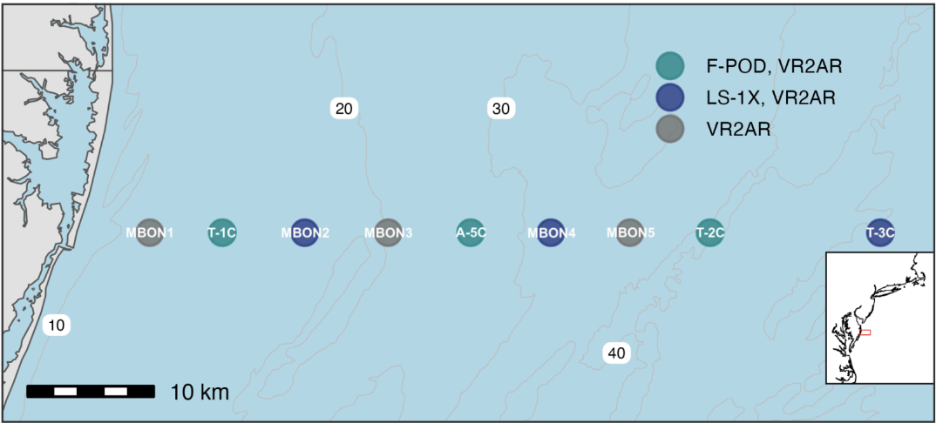
The Mid-Atlantic MBON project is currently in year two of four. Over the past year, researchers have established a study transect extending 58km east of Ocean City, Maryland, two-thirds of the way across the continental shelf. Researchers co-deployed acoustic receivers and hydrophones on the first transect cruise in late 2024. Since then, they have returned approximately quarterly to download data and service equipment. In 2026 and 2027 (years two and three), researchers will embark on monthly cruises from March to November to collect eDNA samples, download data, and service equipment.
Once researchers gather data on species presence (which can come from any combination of PAM, acoustic telemetry, and eDNA) and environmental variables (such as water temperature and salinity, ocean color, and currents), they can develop models to predict presence based on those same variables. Statistical analysis allows them to determine which environmental variables best predict presence, and what range of that variable is most likely to show the highest abundance of that species.
Using these data, the team will design products that are accessible and responsive at multiple geographic and time scales corresponding to management needs. For example, new species distribution models will integrate continuous recordings from PAM and telemetry receivers with eDNA snapshots. These models will complement existing bi-annual surveys by predicting species distributions monthly and can inform broad-scale goals like identifying hotspots for ocean life at a national level as well as species distributions in specific protected areas.
Collecting more biological data will, as principal scientist Dr. Matthew Ogburn of the Smithsonian Environmental Research Center says, “unpack some of those secrets of efficient animal migration and what’s driving it.” These data will provide insights into marine animal movements to protect the variety of life in the waters of the Mid-Atlantic while supporting the millions of people who call the area home.
The U.S. Mid-Atlantic MBON is co-led by MARACOOS and the Smithsonian Environmental Research Center. Collaborating institutions include Blue Wave Consulting Group, Johns Hopkins Applied Physics Laboratory, Smithsonian National Museum of Natural History, RPS (a Tetra Tech Company), Rutgers University, University of Delaware, and University of Maryland Center for Environmental Science. The project features the demonstration of an integrated biodiversity and telemetry observation program in the location of the Maryland Wind Energy Lease Area, leveraging an ongoing monitoring program supported by U.S. Wind, Inc.

Follow the ACT Network on LinkedIn to learn more.